
Approved Document B Compliant Membranes
Selecting products compliant with Approved Document B (ADB) involves choosing materials based on European fire classification (BS EN 13501-1).
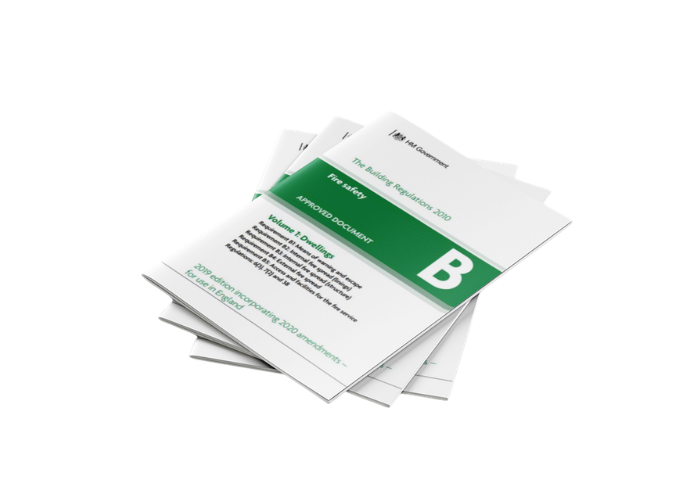
Approved Documents offer comprehensive guidance on adhering to building regulations. Compiled by the government, Approved Documents cover compliance for all aspects of building work, including plumbing, electrics, extensions, and ventilation.
Approved Documents contain:
- Essential guidelines on the expected performance of materials and construction to meet building regulations.
- Practical examples and solutions to achieving compliance for some of the more common building scenarios.
Fire Retardant membranes
A fire retardant membrane acts as a barrier to slow down flames in the event of a fire.
Delta MS 500 Fire Retardant is a BBA certified 8mm studded cavity drain membrane with a Euroclass fire rating of B-S2, d0 (EN 13501-1:2018). Suitable for use on internal faces of earth retained walls, floors, and vaulted ceilings, this fire retardant membrane is a waterproofing membrane designed as a barrier to control water ingress/as a water management system for the protection of below ground structures against the potentially adverse effects of ground water ingress.
This layer is crucial to form not just a waterproof layer, but also act as a barrier to slow down flames (rather than assist the spread of), in the event of a fire.
Fireproof or Fire Retardant?
The term ‘fireproof’ refers to materials that are resistant to fire damage. These materials are incombustible and non-combustible, meaning they cannot ignite or burn.
Fire retardants serve a crucial role in fire safety measures, fire retardant materials possess the unique characteristic to slow down or even halt the spread of fire. This key feature makes them an essential element in fire safety management.
Designed with a specific purpose in mind, Delta MS 500 Fire Retardant Membranes offer notable benefits during a fire incident. Their primary function is to resist ignition, which minimises the chances of a fire starting. Additionally, these membranes are engineered to limit the spread of flames, thus helping control the extent of fire damage. Another crucial feature is their ability to restrict the number of droplets released during a fire, further increasing safety levels.
These membranes are used in construction to ensure the safety of occupants, offering critical time for evacuation in case of a fire. They play a pivotal role in the fire safety design of buildings, contributing to a safer environment.
Approved Document B – Fire Safety (Volumes 1 Dwelling Houses, Volume 2, Buildings in Non-Dwelling Houses)
Future proofing construction projects by specifying fire retardant membranes, like Delta MS 500 Fire Retardant ensures projects meet or exceed current, strict “Approved Document B” fire safety standards.
Significant updates to Approved Document B require choosing materials and systems that balance fire resistance with structural integrity. “….internal linings” means the materials or products used in lining any partition wall, ceiling or other internal structure.
Specialist approaches to structural waterproofing
Specifying products that confirm to Approved Document B (Fire Safety) requires selecting materials and systems that balance fire resistance with adequate protection to water ingress.
Key Product Specification Considerations
- System choice
- Continuous Systems
- Alternative Systems
- Preventing Fire Spread
- Class of materials (A2-s1, d0 or Class A1 (non-combustible))
- Technical Approval body certificate (e.g. BBA)
- Compartmentation
Roof Membranes
Building Regulations Part B (Fire Safety) Part B4 mandates that external walls and roofs must resist fire spread. Section 10 details flat roof coverings including the deck, vapor control layer, insulation, and waterproofing membranes. The 2020 amendment shifts from the national classification system BS 476-3:2004 to the European Classification System BS EN 13501-5, introducing ratings: BROOF(t4), CROOF(t4), DROOF(t4), EROOF(t4), and FROOF(t4).
Roof membranes must comply with BROOF(t4) to meet fire safety standards. Some cold-applied liquids, such as Delta Roof Guard, exceeding the minimum requirement.
Always Happy to Help
Always consult your manufacturer for specific fire classification documents to confirm compliance with Approved Document B regulations.
We are committed to excellence in design and manufacturing collaboration, providing comprehensive PI insurance on all design support and construction of our protection systems. Our installations are fully guaranteed and supported by a nationwide network of Delta Registered Installers.
Whatever the needs of your project, you can rely on Delta’s Technical Team to ensure you get the right advice, support, and practical help at exactly the right time its required. Call us today on 01992 523 523 or email info@deltamembranes.com.